
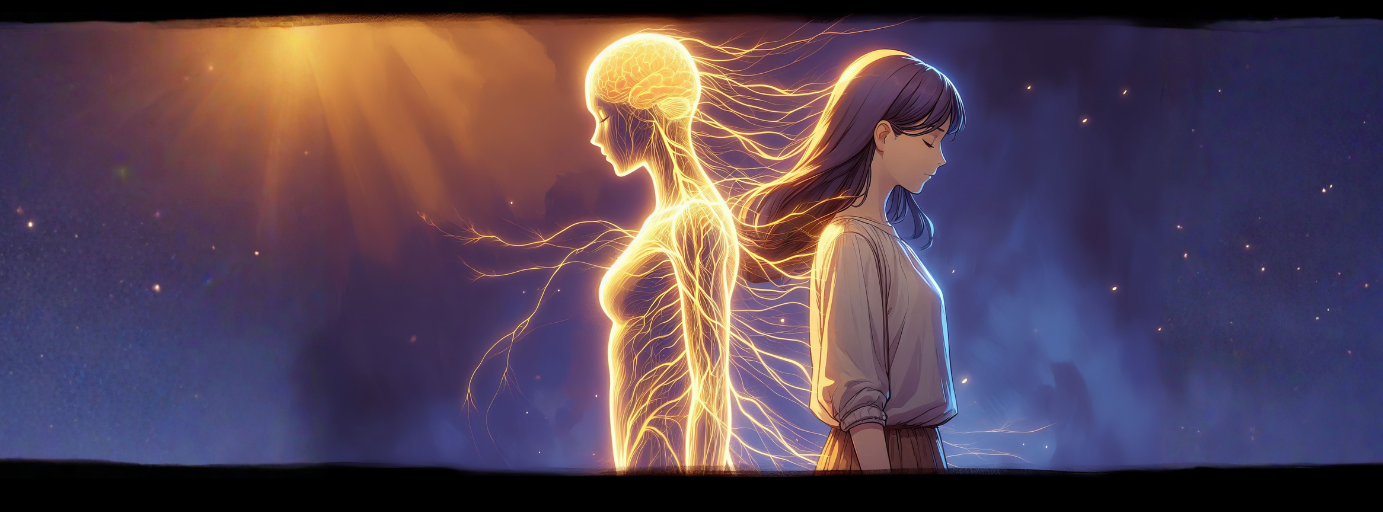

It began, as these reckonings often do, in the middle of the night. At two in the morning. A wave of nausea, intense and absolute. I had been ignoring subtle signs of discomfort for a few hours. Forced myself to go to sleep
The next moment, I was on the cold bathroom floor, heaving, shivering, disoriented, my body revolting against its own silence.
In the rush to get there, I slipped on a puddle my dog had left after drinking water. I fell hard against the tiles and hit the wall with enough force to make the room spin. My knee throbbed, my elbow felt raw, and I had my hands clamped over my mouth in a desperate attempt to contain what was already spilling over.
Then came the anger. White-hot anger. Not at the pain, not even at the sickness, but at myself.
That old, punishing voice rose immediately.
Get up. You’re fine. Don’t be dramatic. You’ve been through worse.
It’s a voice that’s easy to mistake for discipline. The kind that whispers that weakness is shameful. That needing rest is proof of failure.
Lying there, trembling and furious, I realized how practiced I had become at this particular form of cruelty and how reflexively I’d learned to meet pain with denial.
I grew up in a place where exhaustion was suspicious, where “rest” was said with an eye-roll, and where being tired was equated with being lazy. Pain was “just all in your head.” The body, I learned early, was something to conquer. Pain was a test of will. Fatigue, a moral failing. So I became good at pretending to be fine. I performed strength so well that I began to confuse it with identity.
Even when I broke my back.
The snap was unmistakable — a piercing, breath-stealing pain that made my vision blur. Still, I stood up, smiling, telling everyone I was fine. I grit my teeth against the pain and obstinately refused to acknowledge it. Two weeks later, I collapsed and woke up in a hospital with an MRI glowing above me and a doctor shaking his head.
It took major spinal surgery, months of immobility, and years of slow recovery before I could move without pain. I lost my job. A job that had become part of my identity. When the doctor told me the damage could have been prevented if I’d come in immediately after the accident., I didn’t need to ask how it happened. I already knew. It was the cost of that relentless voice that said, keep going, don’t make a fuss, you’re fine.
According to the American Psychological Association’s 2023 Work and Well-Being Survey, nearly three in five employees report experiencing the effects of burnout, with symptoms ranging from emotional exhaustion to physical illness. The APA noted that chronic stress reshapes the brain’s regulatory systems, flooding the body with cortisol until even basic recovery becomes compromised.
What we casually call “burnout” is not simply tiredness. It’s the body declaring insolvency. It’s a form of physiological bankruptcy after years of emotional overdraft.
Neuroscience confirms what we already feel in our bones: the line between emotional and physical pain is almost nonexistent. The same neural pathways, the anterior cingulate cortex and the insula, activate whether we’ve been physically injured or emotionally overwhelmed. When we ignore emotional distress, the brain processes it like a wound left untreated.
The result? The nervous system keeps trying to heal something we won’t admit is broken.
This is why burnout doesn’t just feel like exhaustion. It feels like emptiness. It isn’t the absence of energy; it’s the body’s final attempt to force stillness when we refuse to stop.
At the end of the year, this pattern becomes almost universal. Everyone is rushing to finish, to prove, to produce, in the hope of crossing a finish line that keeps moving further away. We tell ourselves, I’ll rest once everything’s done. But nothing is ever done.
So we keep borrowing from the future (sleep, health, peace) as if our bodies were infinite accounts.
The APA warns that this “chronic overextension” leads to allostatic load; the cumulative wear and tear on the body’s systems caused by prolonged stress. When the stress response never turns off, adrenaline becomes baseline, cortisol becomes the body’s mother tongue, and recovery becomes impossible.
The immune system weakens. Memory falters. Small irritations become unbearable. Energy is rationed; digestion slows; inflammation spreads. It’s not moral failure. It’s biology under siege.
Yet we keep going. Because stopping feels dangerous.
For many of us, that compulsion isn’t ambition. It’s conditioning. When you’ve learned that love is earned through usefulness, rest feels like guilt. When your worth has always been measured in output, stillness feels like risk.
Psychologists call this learned overfunctioning, which is a trauma response often mistaken for dedication. It’s what happens when the body adapts to stress by normalizing it. Stillness becomes intolerable because silence amplifies what we’ve worked so hard to outrun: grief, emptiness, unmet need. The nervous system can only absorb so much of that tension before it begins to fray. Eventually, it has to choose: crash or cry for help.
This is not a new phenomenon. It’s cultural.
We live in a world that glorifies exhaustion. We measure devotion in output, not integrity. The cult of productivity has rebranded overextension as excellence, and somewhere along the line, we began confusing collapse with commitment. It’s not just our jobs. It’s our social media feeds, our friendships, even our sense of self. “Busy” has become a virtue, while rest feels like betrayal. But beneath that is fear. The fear of being seen as unimportant. The fear that if we stop moving, we’ll lose our place in a world that prizes momentum over meaning.
The APA’s research also shows that people experiencing burnout are significantly more likely to develop anxiety, depression, cardiovascular disease and insomnia. Chronic stress doesn’t just wear down the mind, it physically changes the heart, the brain, and the immune system.
This isn’t poetic exaggeration. It’s data.
A 2022 meta-analysis published in Frontiers in Psychology found that long-term burnout shrinks gray matter in areas related to emotional regulation and empathy. When we run on empty long enough, we literally lose the neural capacity to feel as deeply as we once could. We stop recognizing ourselves.
That’s why burnout feels so strange. It erases the very parts of us that could help us heal. The body shuts down to protect itself, and we interpret that shutdown as failure. But it isn’t failure. It’s rebellion.
The body has only one loyalty, and that’s to its own survival.
As Dr. Gabor Maté wrote, “The body says no when we can’t.” That “no” might come as illness, collapse, anxiety, or pain. The body doesn’t punish; it protects. It tells the truth we’re unwilling to hear in any other language.
When I finally stopped fighting that night, let the tears come and let exhaustion spread like ink through my veins I felt something I hadn’t in years: honesty. Not composure. Not strength. Just honesty.
I realized how many times I’d asked my body to prove its pain before I believed it. How I would ask if this is enough pain to even allow myself to admit that I am indeed feeling any pain.
If anyone else had come to me describing what I felt (the shaking, the dizziness, the tears) I would have said, You need rest. You need care. But to myself, I said, Stop being dramatic.
It’s astonishing how easily we turn compassion into a currency as something we think we have to earn, even from ourselves.
Burnout isn’t a badge of honour. It’s a wound dressed up as achievement. It’s what happens when we mistake depletion for devotion and endurance for excellence.
And it is costing us.
Dr. Christina Maslach, one of the foremost researchers on burnout, wrote, “Burnout is not a failure of the individual. It’s a mismatch between the person and the environment they’re forced to survive in.” That mismatch is everywhere: in workplaces that praise overwork, in cultures that romanticize hustle, in families that celebrate endurance while dismissing emotion. The result is a population of people who confuse adrenaline for purpose.
When we push through pain, we’re not building resilience. We’re creating debt. Each time we ignore exhaustion or swallow a boundary, we’re writing a cheque our bodies will one day cash. The bill doesn’t always come immediately, but make no mistake, it will come, and often when it’s the most inconvenient. It sometimes comes as chronic illness, sometimes as emotional numbness. Sometimes, in ways we do not expect nor are prepared for.
The body is not forgetful. It’s faithful. It keeps a record of every unspoken truth, every moment we said I’m fine when we weren’t. And when it finally speaks, it does so with authority.
When the fatigue becomes bone-deep, when small things start to feel unbearable, when joy begins to feel foreign it isn’t weakness. That’s the body calling in the debt.
That’s the nervous system saying, I can’t keep you alive this way.
If you are reading this and you’re tired, not the kind of tired that sleep fixes, but the kind that makes you ache behind your eyes, please know this: your body isn’t betraying you. It’s trying to bring you home.
You don’t have to earn rest. You don’t have to justify slowing down. You only have to recognize that exhaustion is evidence of care and that you’ve tried too hard for too long, often for things that have never tried to care for you back.
The end of the year doesn’t require perfection. It requires permission to stop, to soften, to breathe and to recover. You don’t need another resolution. You need restoration. Because if the body’s whispers are ignored long enough, they turn to shouts. And if we still don’t listen, it shuts us down completely. That isn’t punishment. That’s preservation. It’s biology, not betrayal.
The body isn’t your enemy. It’s your oldest friend. The one who’s stayed awake all these years keeping score, waiting patiently for you to remember what being alive actually feels like.
Strength isn’t found in pushing through. It’s found in listening sooner. In refusing to measure your worth by your endurance. In believing that gentleness isn’t the opposite of resilience, but what makes it sustainable.
The truth is simple, though rarely comfortable: when you ignore the whispers, the body will start to shout. And if you still don’t listen, it will stop you.
That’s not weakness. That’s wisdom. That’s the body insisting on life. So stop before it stops you. Listen now. Because the body always sends the bill and its currency is time you don’t get back.
– Originally written for Being Well Psychology’s November theme on Burnout, and shared here on Tightrope High
Leave a Reply