

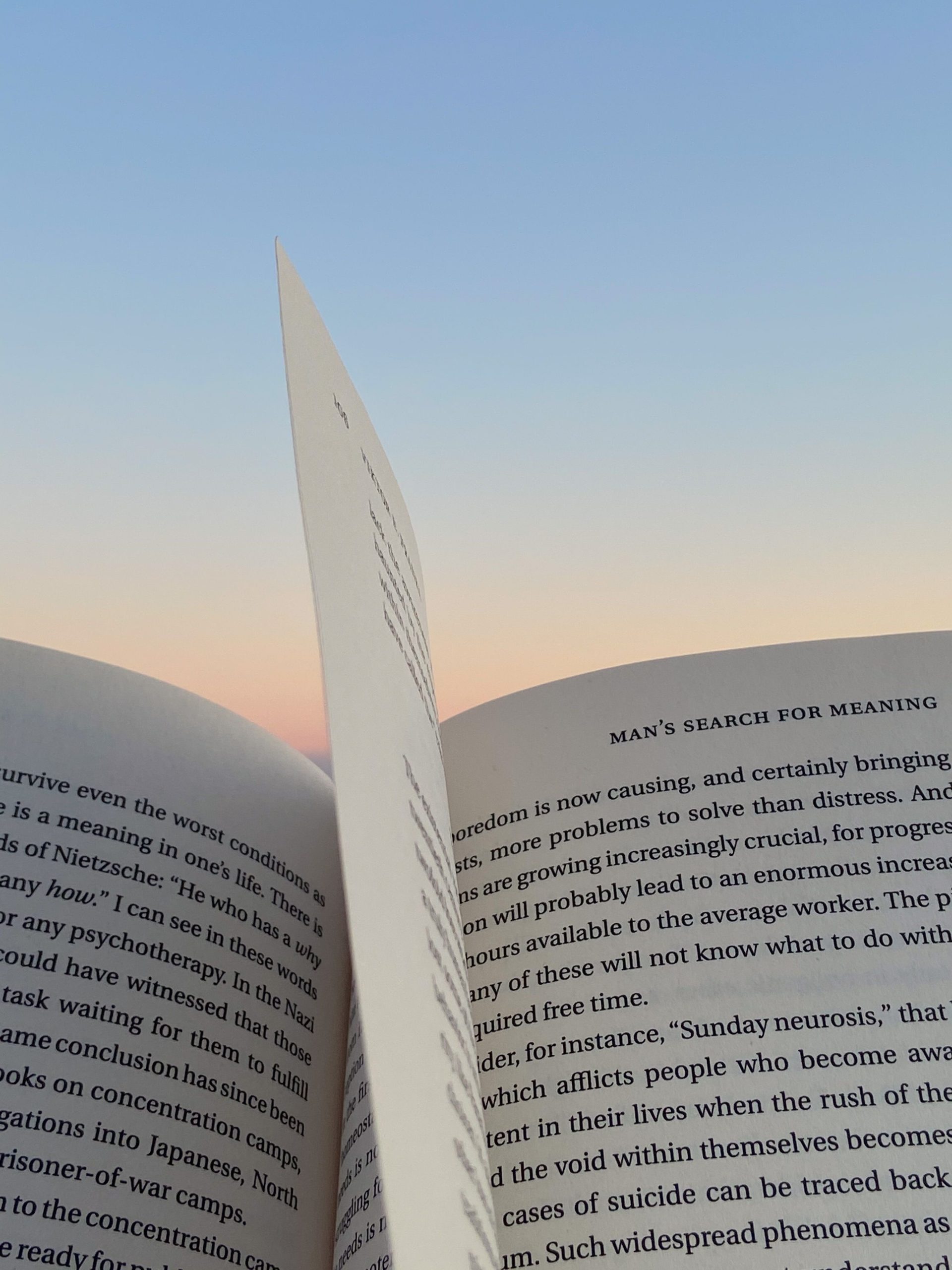
“It is one of the basic tenants of logotherapy that man’s main concern is not to gain pleasure or avoid pain but rather to see a meaning in his life. That is why man is even ready to suffer, on the condition, to be sure, that his suffering has a meaning”
– Viktor Frankl, Man’s Search for Meaning
When most of us think about mental health care, we think about treating the symptoms of our inner turmoil. This could include trouble sleeping, constant worry, a heaviness that won’t lift or even dissociation, where we fail to feel and/or experience anything. All of these are real and treating them matters. But anyone who has found themselves in a difficult season of life – whether it be losing a job, the end of a relationship or grieving the death of a loved one – knows that there is often a deeper question sitting underneath the symptoms, one that tends to be the hardest to put into words: What is the point of all this? Why should I keep going? Why me?
Those questions especially deserve a place in the therapy space.
For many Namibians, these questions are painfully real. Supported by the World Health Organization (WHO), our country marks National Mental Health Promotion and Suicide Prevention Month from 10 September to 10 October, with a focus on changing the narrative on suicide and making sure people with lived experience are heard. The need is urgent and close to home. In an article published on 16 September 2026, the Informanté revealed that the Namibian Police recorded 486 suicide cases across the country in the 2025/2026 financial year, and 390 of them were adult men. Each of those numbers was a whole life: a person with a history, hopes still unfinished, and people who are now left carrying their absence. What all the pressures of life that lead people to consider suicide often have in common is that they shake a person’s sense of purpose: their role as a provider, their place in a family, their belief that tomorrow holds something worth waiting for. When that sense of meaning fades away and becomes a distant memory, symptoms can grow and worsen in the empty space it leaves behind.
In her recent post, ‘How to talk to someone having suicidal thoughts’, our clinical psychologist, Iani de Kock, described a question that can be a lifeline in a moment of crisis: not only why do you want it to end? but also what has kept you here? That second question points to something at the very core of good mental health care. The people we love, the things we still hope to do, the values we refuse to part with; these are the moments of meaning that comfort us, and in therapy they can become the foundation for building a life that feels worth living again.
The Austrian psychiatrist, Viktor Frankl, understood this deeply. Having survived tragedy in his own life, he came to believe that our search for meaning is not a luxury or an afterthought, but the most fundamental drive in human life. He often returned to the words of Friedrich Nietzsche: “He who has a why to live for can bear almost any how.” From that insight he developed logotherapy, an approach that helps people discover what still matters to them, even in circumstances they cannot change. In this post, we’ll explore what meaning-centered therapy (specifically logotherapy) is, why it speaks so directly to the struggles many Namibians face, and how it can work alongside other forms of care to offer not just relief, but most importantly, TO INSTIL HOPE.
What is logotherapy?
Logotherapy was developed by Viktor Frankl, and its name comes from the Greek word logos, which can be translated as ‘meaning’. Where many approaches to therapy ask what is wrong with you?, logotherapy asks what is life still asking of you?
At its core are three simple but deeply powerful ideas. Firstly, in contrast to Adler’s will-to-power and Freud’s will-to-pleasure, Frankl holds that the deepest human need is meaning, a sense that our lives matter and are pointed toward something worthwhile. Secondly, he states that meaning is never completely out of reach, even in the hardest circumstances. Thirdly, he maintains that we always keep some freedom, however small, in how we respond to what happens to us.
“It is one of the basic tenants of logotherapy that man’s main concern is not to gain pleasure or avoid pain but rather to see a meaning in his life. That is why man is even ready to suffer, on the condition, to be sure, that his suffering has a meaning.”
– Viktor Frankl, Man’s Search for Meaning
Frankl described three main ways people find meaning. We find it through what we GIVE to the world, in other words, our work, our contributions, the things we create or do for others. We also find it through what we RECEIVE from the world, that is, love, relationships, beauty, faith, the experience of being truly connected to someone. And when we face suffering we cannot change, such as a loss, an illness, or an injustice, we can still find meaning in the ATTITUDE we take toward it and the kind of person we choose to be in the middle of it.
Frankl noticed something that many people feel but struggle to describe to others: an inner emptiness, a sense that life has gone purposeless. He called this the ‘existential vacuum’. It isn’t a diagnosis in the usual sense, but it can quietly feed depression, anxiety, anger, and unhealthy ways of coping. Logotherapy doesn’t ignore these symptoms; instead, it looks beneath them to ask whether a person has lost touch with what makes life feel worth living.
Importantly, a therapist should not hand anyone a meaning or tell them what their purpose should be. That would be contrary to the very premise on which logotherapy is built. Meaning cannot be prescribed; it must be discovered. The therapist’s role is more like that of a guide, asking thoughtful questions that help a person notice what they value, who they are responsible to, and what might still be waiting for them in the future.
“Life ultimately means taking responsibility to find the right answer to its problems and to fulfil the tasks which it constantly sets for each individual.”
– Viktor Frankl, Man’s Search for Meaning
Why meaning speaks so directly to the struggles of Namibians
Let us look at an example: a husband and father was retrenched after fifteen years at his job. His pain is not only about money. He has lost his role as a provider and the respect that came with it, and he quietly wonders what his purpose will be without that. For many Namibian men especially, identity is closely tied to being able to support a family, and when that is taken away, it can feel like losing one’s reason to exist. Logotherapy speaks directly to this. It helps a person see that their worth was never only in their paycheque. A father is still a father, a son is still a son, and there are still ways to contribute, to guide, to love, and to be needed.
This connects closely to something Iani de Kock described in her September blog post: the painful belief that “everyone would be better off without me”. Frankl placed great emphasis on each person’s uniqueness. There are people only you can be there for, and a part in their lives that no one else can fill. Gently helping someone rediscover this can be a powerful counter to the feeling of being a burden.
Meaning-centered therapy also sits comfortably with values many Namibians already hold. The spirit of ubuntu, the understanding that I am because we are, is very close to Frankl’s belief that we find ourselves most fully when we reach beyond ourselves toward others. For people of faith, logotherapy is respectful of spiritual life and leaves room for it, rather than treating it as something to be explained away. For many clients, therapy that honours family, community, and perhaps faith feels far more natural than an approach focused only on the individual.
Finally, logotherapy is honest about the fact that some things cannot be fixed. Unemployment, poverty, illness, and grief are real, and no amount of positive thinking makes them disappear. Meaning-centered work doesn’t pretend otherwise, and it should never be used to suggest that people simply need a better attitude. What it offers is a way to stand in the middle of hardship without losing oneself, like the mother caring for a sick parent who discovers that her love and faithfulness are themselves deeply meaningful, even when she cannot change the outcome.
“Everything can be taken from a man but one thing: the last of the human freedoms – to choose one’s attitude in any given set of circumstances, to choose one’s own way.”
– Viktor Frankl, Man’s Search for Meaning
Working alongside other forms of care
Logotherapy is not a replacement for other forms of help. When someone is in crisis, the first priority is always safety: being with them, reaching out to family, and connecting them with professional support as quickly as possible. Some people will benefit from medication prescribed by a psychiatrist, practical support from a social worker, or skills-focused approaches like Mindfulness-Based Stress Reduction (MBSR) and Cognitive Behavioral Therapy (CBT) that help with overwhelming thoughts, sleep, and day-to-day functioning.
Meaning-centered work fits alongside all of these. You can think of it this way: other treatments can help a person get their feet back on solid ground, while meaning-centered therapy helps them decide which direction to walk once they’re standing. Symptom relief matters, and it often makes the search for meaning possible in the first place. But relief on its own can leave a person asking, better for who and for what? Meaning answers that question.
“But there was no need to be ashamed of tears, for tears bore witness that a man had the greatest of courage, the courage to suffer.”
– Viktor E. Frankl, Man’s Search for Meaning
From relief to hope
Hope, in the way that Frankl understood it, is not the same as optimism or believing that everything will turn out fine. It is the discovery that there is still something worth living for: a person, a task, a value, a future moment that needs you. He even spoke of a kind of ‘tragic optimism’, the ability to say yes to life despite pain, loss, and uncertainty.
This is where meaning-centered therapy offers something that goes beyond easing symptoms. When the young woman whose relationship ended begins to see that her capacity to love wasn’t lost with that relationship, or when the retrenched father realises his children still look to him for guidance, something shifts. The pain doesn’t vanish, but it no longer has the final word. There is a reason to get up tomorrow.
“In some ways suffering ceases to be suffering at the moment it finds a meaning, such as the meaning of a sacrifice.”
― Viktor E. Frankl, Man’s Search for Meaning
Finding your own “why”
One thing you need to understand is that meaning is rarely found all at once. More often, it is noticed in small moments, and sometimes it only becomes clear when we slow down enough to look. How beautiful is it to know that we have the opportunity for someone to guide us in recognising and appreciating these small moments.
If you’re going through a difficult season, you might gently ask yourself:
- Who in my life would I want to show up for, and who still needs me?
- What have I cared about, or hoped to do, that still matters to me?
- What has helped me hold on through difficult times before?
You don’t need to have the answers right away. Simply asking the questions is a first step, and you don’t have to explore them alone.
At Being Well Psychology, we believe that good mental health care is about more than reducing symptoms. It’s about helping people reconnect with what makes their lives feel worth living. Whether you’re struggling yourself or worried about someone you love, reaching out is a sign of strength, not weakness.
“The salvation of man is through love and in love. I understand how a man who has nothing left in this world still may know bliss, be it only for a brief moment, in the contemplation of his beloved”
– Viktor Frankl, Man’s Search for Meaning
Leave a Reply